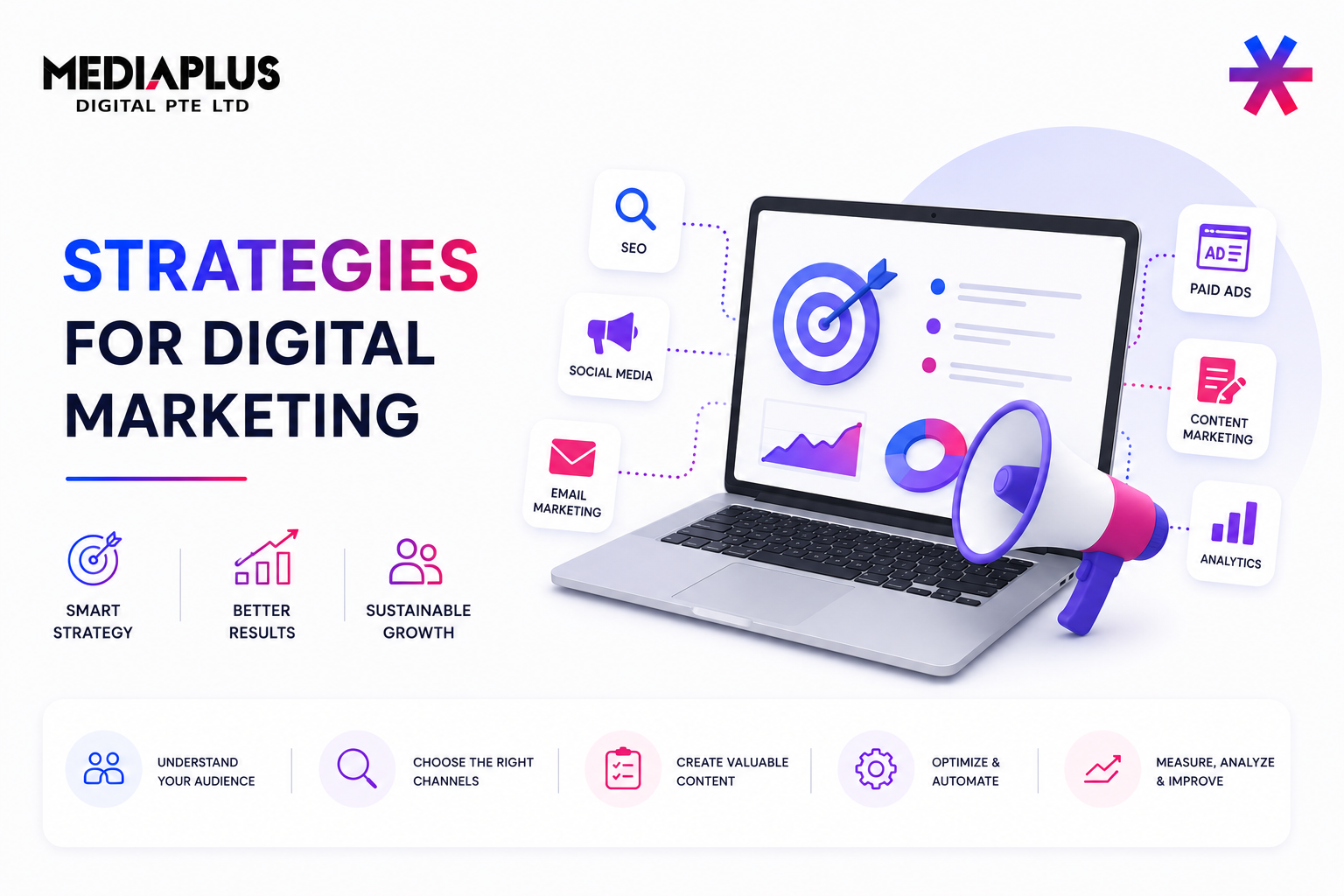
A digital marketing strategy is no longer optional. It is the backbone of how modern businesses attract attention, build trust, and convert audiences into long-term customers.
As digital channels continue to fragment and customer journeys become more complex, companies that rely on isolated tactics often struggle to scale. Those that succeed treat digital marketing as a connected system, guided by strategy rather than short-term execution alone.
This guide explains what a digital marketing strategy really is, how it works, how it differs from campaigns and tactics, and how businesses can build one that delivers measurable and sustainable results.
What Is a Digital Marketing Strategy?
A digital marketing strategy is a long-term plan that defines how a business will use digital channels to achieve specific commercial goals.
It connects business objectives with audience insights, channel selection, messaging, budget allocation, and measurement frameworks. Unlike individual campaigns, a strategy sets direction and priorities over time.
At its core, a digital marketing strategy answers two essential questions:
What outcomes does the business want to achieve
Why do these outcomes matter to growth, revenue, or positioning
A strong strategy ensures that every digital activity, whether SEO, paid media, content, or social, contributes to a shared goal rather than operating in isolation.
Strategy vs Campaigns vs Tactics
One of the most common mistakes in digital marketing is confusing strategy with execution.
- A strategy defines the long-term vision and success metrics.
- A campaign is a focused initiative designed to support that strategy.
- A tactic is the specific action taken within a campaign.
For example:
- A strategy might aim to grow qualified inbound leads by 30 percent over twelve months.
- A campaign could focus on thought leadership content targeting decision makers.
- Tactics would include publishing SEO articles, running LinkedIn ads, and hosting webinars.
When these layers are aligned, marketing becomes more efficient, consistent, and scalable.
What a Strong Digital Marketing Strategy Looks Like
While every business is different, high-performing digital marketing strategies are built on four core pillars.
1. Clear Business Goals
Goals anchor the strategy to commercial outcomes rather than vanity metrics.
Examples include:
- Increasing qualified leads
- Improving conversion rates
- Expanding into new markets
- Reducing customer acquisition cost
Well-defined goals help teams prioritise channels, content, and budgets with purpose.
2. Deep Audience Understanding
Strategy starts with people, not platforms.
This includes:
- Buyer personas based on data, not assumptions
- Understanding pain points, motivations, and objections
- Mapping user intent across the buying journey
When audience insights are clear, messaging becomes more relevant and conversion rates improve naturally.
3. Smart Budget Allocation
A strategy determines where to invest and where not to.
Instead of spreading budget thinly across every channel, high-performing strategies focus on channels that align with audience behaviour and business goals.
This often means balancing:
- Long-term channels like SEO and content
- Mid-term channels like email and organic social
- Short-term accelerators like paid search and paid social
4. Measurement and Optimisation Frameworks
Without measurement, strategy becomes guesswork.
A strong digital marketing strategy defines:
- Key performance indicators that reflect real value
- Tracking systems across channels
- Clear review cycles for optimisation
Metrics such as cost per lead, conversion rate, customer lifetime value, and revenue attribution matter far more than surface-level engagement.
Core Levers of a Digital Marketing Strategy
A digital marketing strategy only creates value when it is executed well. Execution happens through a set of core levers. These levers are the channels, tools, and methods that translate strategic intent into measurable results.
Each lever plays a different role. The key is not using all of them, but using the right mix based on business goals, audience behaviour, and stage of growth.
Content Marketing
Content marketing is a long-term growth lever built on relevance and consistency.
High-quality content helps businesses earn attention rather than interrupt it. Blogs, in-depth guides, case studies, videos, and thought leadership pieces educate audiences, answer real questions, and position brands as credible problem solvers.
When aligned with user intent, content supports multiple objectives at once. It strengthens SEO performance, generates qualified leads, supports sales conversations, and builds trust over time. Poorly aligned content, however, becomes noise. Strategy determines what content is created, who it is for, and how it moves users forward.
Search Engine Optimisation (SEO)
SEO is one of the most important foundations of a sustainable digital marketing strategy.
By optimising content, structure, and technical performance around search intent, SEO enables brands to capture demand at the exact moment users are looking for solutions. Unlike paid channels, SEO compounds over time and continues to deliver value without increasing cost per click.
Strong SEO supports the entire funnel. Informational content attracts early-stage research traffic, comparison pages assist decision-making, and product or service pages convert high-intent users. When done strategically, SEO becomes a reliable engine for consistent, cost-efficient growth.
Paid Media and Performance Marketing
Paid media provides speed, precision, and control.
Channels such as Google Ads, Meta, LinkedIn, and other performance platforms allow marketers to reach specific audiences quickly, test messaging, and scale offers that have proven demand. Paid media is particularly effective for product launches, market entry, and accelerating growth once conversion paths are validated.
The difference between profitable and wasteful paid media lies in strategy. Without clear objectives, tracking, and alignment with the broader funnel, paid campaigns become short-term fixes. When guided by strategy, they become a powerful lever for predictable acquisition.
Social Media Marketing
Social media plays different roles depending on the business and audience.
For some brands, social platforms are primarily awareness and brand-building channels. For others, they support demand generation, content distribution, customer engagement, or community development.
Effective social media marketing is not about posting frequently. It is about using the right platforms to reinforce positioning, amplify content, and support other levers such as SEO, paid media, and email. Strategy defines which platforms matter, what success looks like, and how social contributes to overall business goals.
Email Marketing and Automation
Email remains one of the highest ROI digital marketing channels when used strategically.
Rather than acting as a broadcast tool, email works best as a structured communication system. It nurtures leads, educates prospects, re-engages inactive users, and increases lifetime value through personalised messaging.
With automation and segmentation, email scales personalisation across thousands of users. This makes it especially effective for long buying cycles, retention strategies, and cross-sell or upsell initiatives. Within a strategy, email often connects acquisition channels to long-term revenue.
Data, Analytics, and Marketing Technology
Data is the backbone of modern digital marketing strategy.
Analytics platforms, CRM systems, and marketing automation tools allow teams to measure performance accurately, understand user behaviour, and make informed decisions. Without clean data and proper tracking, optimisation becomes guesswork.
Integrated marketing technology enables attribution across channels, personalisation at scale, and continuous improvement. The most effective strategies treat data not as a reporting function, but as an active input into planning, execution, and optimisation.
How to Build a Digital Marketing Strategy Step by Step
Building a digital marketing strategy is not about choosing tools or launching campaigns first. It is about creating a structured system that links business goals to execution and measurement. Each step builds on the one before it, and skipping steps usually leads to wasted budget or inconsistent results.
Step 1: Define Clear Business Objectives
Every effective digital marketing strategy starts with clear outcomes.
Before selecting channels or planning campaigns, define what success actually looks like for the business. These objectives should be tied directly to commercial impact, not surface-level metrics.
Common strategic objectives include:
- Increasing qualified leads or enquiries
- Growing online revenue
- Improving conversion rates across key funnels
- Reducing customer acquisition cost
- Expanding into new markets or segments
Well-defined objectives give marketing teams a decision framework. When trade-offs arise, teams can evaluate every tactic based on whether it supports these outcomes.
Step 2: Research and Define Your Audience
A strategy only works if it is built around real user behaviour.
This step focuses on developing accurate buyer personas using both quantitative and qualitative data. Guesswork leads to generic messaging and poor performance.
Effective audience research typically includes:
- Website and analytics data to understand traffic sources and behaviour
- CRM data to analyse lead quality and customer lifetime value
- Surveys and interviews to uncover motivations, objections, and pain points
- Search data to identify intent and information needs
The goal is to understand how people discover solutions, how they compare options, and what influences their final decision. This insight shapes messaging, channel selection, and content strategy.
Step 3: Audit Existing Assets and Channels
Before investing in new initiatives, evaluate what is already in place.
A digital marketing audit provides clarity on which channels and assets are contributing to business goals and which are underperforming.
Key areas to review include:
- SEO performance, keyword coverage, and content gaps
- Paid media efficiency and return on ad spend
- Content quality, relevance, and conversion impact
- Social media engagement and referral traffic
- Email performance, segmentation, and automation flows
This step helps teams identify quick wins, eliminate waste, and prioritise improvements that deliver the highest impact.
Step 4: Select Channels and Prioritise Efforts
Not all channels deserve equal attention.
Channel selection should be driven by audience behaviour, competitive dynamics, and expected return on investment. A strong strategy focuses resources where they are most effective rather than spreading effort too thin.
For example:
- Search and SEO may be critical for high-intent demand capture
- Paid media may be needed to accelerate growth or test new markets
- Content may support longer sales cycles or complex B2B decisions
- Email may be central for retention and lead nurturing
Each selected channel should have a clearly defined role within the strategy and measurable contribution to overall goals.
Step 5: Define KPIs and Tracking Frameworks
Without measurement, optimisation is impossible.
This step ensures that success can be tracked accurately and consistently across channels. KPIs should reflect real business value rather than vanity metrics.
Common strategic KPIs include:
- Cost per lead or cost per acquisition
- Conversion rates across key user journeys
- Marketing qualified leads and sales qualified leads
- Revenue attribution by channel
- Customer lifetime value and retention rates
Equally important is ensuring analytics tools, attribution models, and reporting systems are in place before scaling spend or content production.
Step 6: Execute, Review, and Optimise Continuously
A digital marketing strategy is not a one-time exercise.
Once execution begins, performance data should be reviewed regularly to identify patterns, inefficiencies, and opportunities for improvement. High-performing teams treat optimisation as an ongoing process, not a reactive fix.
This includes:
- Refining targeting and messaging based on engagement and conversion data
- Adjusting budgets toward higher-performing channels
- Testing and iterating content formats and landing pages
- Responding to changes in user behaviour and market conditions
Consistent review and optimisation are what transform a solid strategy into a sustainable growth engine.
Why Digital Marketing Strategy Matters More Than Ever
Digital competition is increasing, customer attention is shrinking, and acquisition costs continue to rise.
A clear digital marketing strategy helps businesses:
- Avoid wasted spend
- Align teams and stakeholders
- Build consistent brand experiences
- Scale marketing efforts sustainably
Without strategy, marketing becomes reactive. With strategy, marketing becomes a growth engine.
Digital Marketing Strategy Support from MediaPlus Singapore
For businesses that want execution backed by strategy, MediaPlus Singapore provides end-to-end digital marketing services designed to drive measurable growth.
Their services include:
- Digital marketing strategy development
- SEO services focused on long-term organic growth
- Performance marketing service and paid media management
- Content marketing and conversion optimisation
- Analytics, tracking, and CRM integration
MediaPlus approaches digital marketing as a connected system, not a collection of tactics. By aligning strategy, data, and execution, they help businesses turn digital activity into predictable revenue outcomes.
If your goal is not just traffic, but qualified leads, conversions, and scalable growth, working with a strategic digital marketing partner makes the difference.
Final Thought
A digital marketing strategy is not a document that sits on a shelf. It is a living framework that guides decisions, adapts to data, and evolves with the market.
Businesses that invest in strategy before execution consistently outperform those that chase tactics alone.