A business website is no longer just an online brochure. For most companies, it is the first point of contact, the main sales touchpoint, and often the deciding factor in whether a customer chooses you or a competitor.
Research consistently shows that users form an opinion about a website within seconds. A poor experience leads to lost trust, higher bounce rates, and missed revenue opportunities. A strong website, on the other hand, acts like a silent salesperson, guiding visitors from interest to action with clarity and confidence.
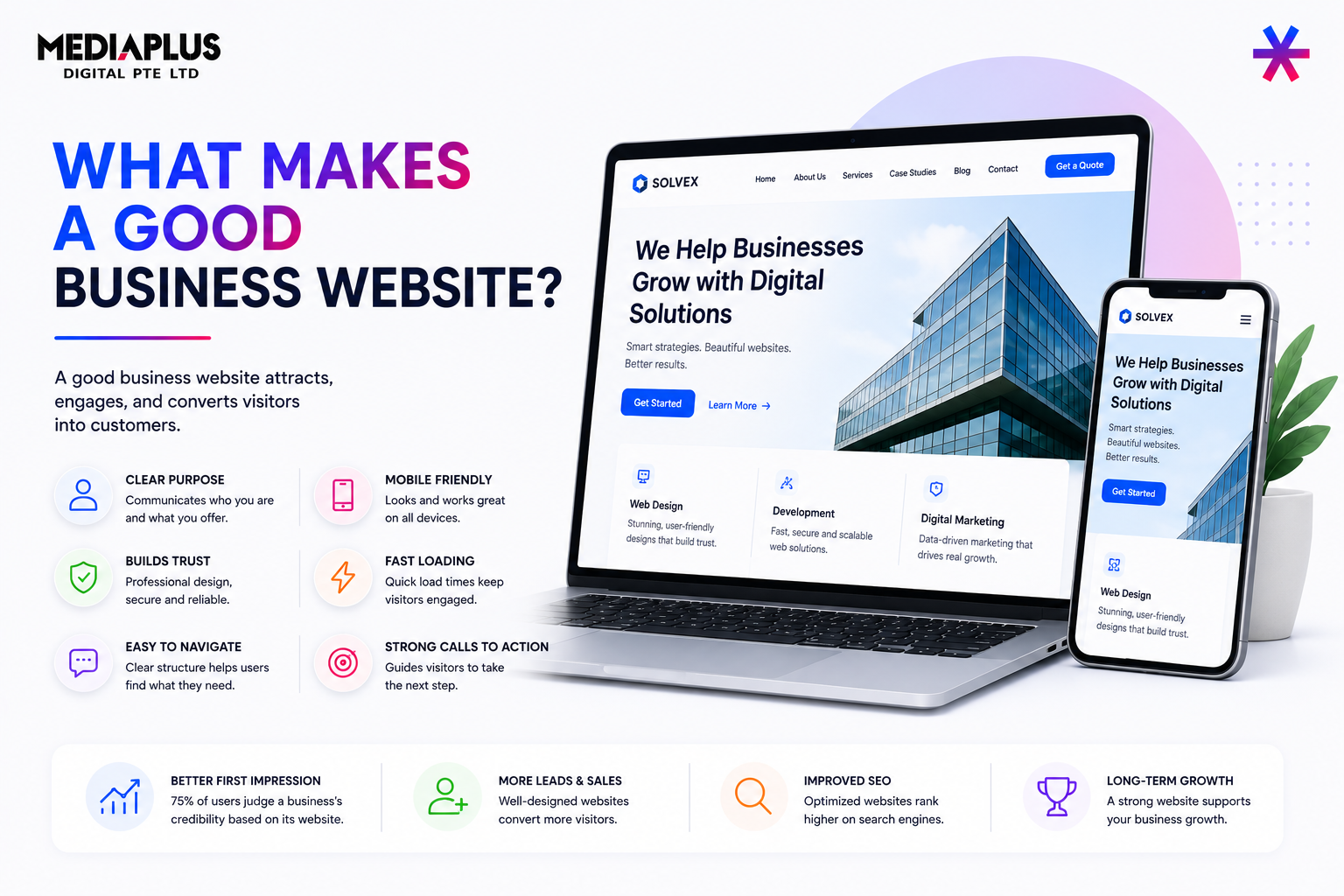
So what actually makes a good business website today? Below are the core elements that consistently separate high-performing websites from those that underdeliver.
1. Clear Purpose and Value Proposition
A good website immediately answers three questions for visitors:
-
Who are you?
-
What do you offer?
-
Why should they care?
Your value proposition should be visible above the fold and reinforced throughout the site. This is not about clever wording, but about clarity. Visitors should instantly understand how your business solves their problem or improves their situation.
2. User-Centered Design and Navigation
Good design is not about decoration. It is about usability.
An effective website uses clean layouts, logical structure, and intuitive navigation so users can find what they need without effort. Menus should be clear, page hierarchies should make sense, and important actions should never feel hidden.
When users do not have to think about how to navigate, they are more likely to stay, explore, and convert.
3. Strong Visual Hierarchy and Brand Consistency
Visual hierarchy helps users understand what matters most on each page. Headings, spacing, typography, and color contrast should guide attention naturally.
At the same time, branding must be consistent. Fonts, colors, imagery style, and tone of voice should feel cohesive across all pages. Consistency builds familiarity, and familiarity builds trust.
4. Clear and Focused Calls to Action
Every page should have a purpose, and that purpose should be supported by a clear call to action.
Effective CTAs:
-
Use direct, action-oriented language
-
Stand out visually without overwhelming the page
-
Align with user intent at that stage of the journey
Whether the goal is to request a quote, make a purchase, or book a consultation, users should never be unsure about what to do next.
5. Mobile-First Responsiveness
Most website traffic today comes from mobile devices. A good business website is designed mobile-first, not adapted as an afterthought.
This means:
-
Text is readable without zooming
-
Buttons are easy to tap
-
Layouts adapt smoothly across screen sizes
-
Performance remains fast on mobile networks
Mobile usability is also a critical ranking factor for search engines, making it essential for both UX and SEO.
6. Fast Performance and Technical Stability
Speed matters more than many businesses realize. Slow-loading pages lead to frustration, abandonment, and lower conversion rates.
A strong website is built on:
-
Optimized images and assets
-
Reliable hosting infrastructure
-
Clean code and minimal bloat
-
Regular technical maintenance
Performance is not just a technical concern. It directly affects revenue.
7. Search Engine Optimisation Foundations
A good website is discoverable.
SEO should be built into the structure from the start, including:
-
Clean URL structures
-
Proper heading hierarchy
-
Optimized meta titles and descriptions
-
Relevant, intent-driven content
-
Internal linking that supports crawlability
Without solid SEO foundations, even the best-designed website will struggle to attract qualified traffic over time.
8. Relevant, Helpful Content
Content is what turns visits into engagement and trust.
High-quality websites provide content that:
-
Answers real user questions
-
Explains products or services clearly
-
Supports decision-making
-
Demonstrates expertise and credibility
This can include service pages, FAQs, guides, case studies, and educational articles. Content should be written for people first, not just search engines.
9. Credibility and Social Proof
Users want reassurance before they take action.
Trust signals play a major role, such as:
-
Customer reviews and testimonials
-
Case studies or client logos
-
Clear contact information
-
Certifications, awards, or media mentions
These elements reduce hesitation and help users feel confident in choosing your business.
10. Security and Accessibility
A good website is safe and inclusive.
Security measures like HTTPS, secure payment processing, and regular updates protect both the business and its users. Accessibility features such as proper contrast, alt text, and keyboard navigation ensure the site works for a wider audience.
These factors improve usability, compliance, and overall brand reputation.
Final Thoughts: Building a Website That Actually Works
A good business website is not defined by trends or visual appeal alone. It is defined by how well it aligns business objectives with real user behaviour.
When design, performance, content, SEO, and trust signals work together, a website becomes a growth asset rather than a cost. It attracts the right audience, supports meaningful conversions, and scales alongside the business over time.
At MediaPlus Digital Singapore, web design projects are approached as part of a broader digital system, not an isolated deliverable. Their web design Singapore services combine UX strategy, SEO foundations, performance optimisation, and conversion-focused structure from day one, ensuring websites are built to perform, not just to look good.
If a website appears polished but fails to deliver results, the issue is rarely traffic alone. More often, it lies in how the experience is designed. MediaPlus helps businesses turn their websites into platforms that drive visibility, credibility, and long-term digital growth.